I got this blue set for a very specific reason ...
... and it's not because the colour blue doesn't feature much in my collection so far ...
Watch this space!
Sunday, June 28, 2020
Wednesday, June 24, 2020
Ambawari Maharaja set
This set was listed as an 'Ambawari Maharaja' set on eBay. Very different from any other set in my collection, I couldn't resist .... The set came without a board, but I felt it would look good on the same board as I used for my Indian Lotus set.
The pieces are intricately carved, and mainly painted in browns and greens, with lots of added gold.
It's pretty clear which pieces are the kings and queens, and the pawns are also clear. Distinguishing between the rooks, knights and bishops is less easy, as they all come in the shape of animals: camels, horses and elephants, respectively.
The pieces are intricately carved, and mainly painted in browns and greens, with lots of added gold.
It's pretty clear which pieces are the kings and queens, and the pawns are also clear. Distinguishing between the rooks, knights and bishops is less easy, as they all come in the shape of animals: camels, horses and elephants, respectively.
So maybe not the best set to actually play a game with, but a welcome addition to my collection nevertheless!
Saturday, June 13, 2020
African set
African-style chess sets appear on eBay quite often, and in the past, I already got myself a lovely and very tactile soapstone set. When I saw this wooden African set listed, I decide to add it to the collection, as it was clearly different in style from the soapstone set.
Box and pieces are made from some type of wood, and the 'rough' style of the board appealed to me.
No idea whether this set was actually hand-made somewhere in Africa, or mass-produced in a factory in Europe or anywhere else outside of Africa. Nevertheless, I like the design of the pieces.
And I especially like the use of a giraffe for the knights!
Box and pieces are made from some type of wood, and the 'rough' style of the board appealed to me.
No idea whether this set was actually hand-made somewhere in Africa, or mass-produced in a factory in Europe or anywhere else outside of Africa. Nevertheless, I like the design of the pieces.
And I especially like the use of a giraffe for the knights!
Sunday, June 7, 2020
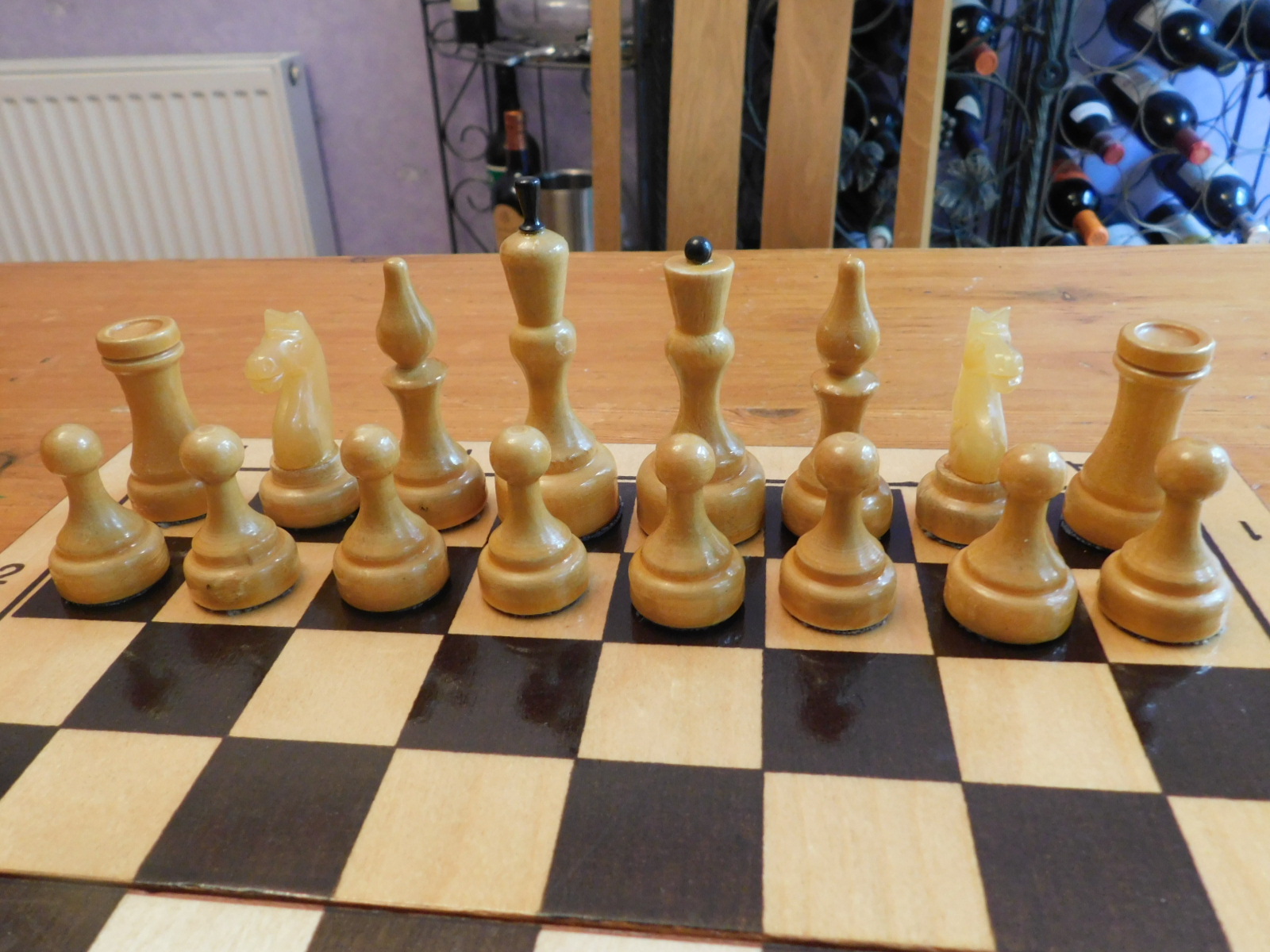
Russian set
Saw this Russian set on eBay; judging from the pictures posted in the listing, the box was pretty tatty, but the board and pieces were in pretty good nick. And so it proved to be indeed.
The king and queen have their tops painted in the 'opposite' colour, which appears to be typical for eastern European chess sets.
The eBay listing didn't give any information on the age of the set, so if anyone has any ideas, I'd love to hear!
Tuesday, June 2, 2020
Batman set
Next addition to my collection of 'fictional' chess sets: a Batman set.
Quite a high-end set for as far as these go. The box includes fancy black and purple pouches to keep the pieces in.
The board is, as usually, a fold-up one, made from cardboard ...
... and the pieces are made from plastoy. They're pretty high quality. I must say.
The set features a number of key items on either side, with the two 'armies' led by The Joker and Harley Quinn on the 'Joker' side, and Batman and Batwoman on the 'Dark Knight' side.
Quite a high-end set for as far as these go. The box includes fancy black and purple pouches to keep the pieces in.
The board is, as usually, a fold-up one, made from cardboard ...
... and the pieces are made from plastoy. They're pretty high quality. I must say.
The set features a number of key items on either side, with the two 'armies' led by The Joker and Harley Quinn on the 'Joker' side, and Batman and Batwoman on the 'Dark Knight' side.
Wednesday, May 27, 2020
'Westernised' xiangqi set
In case you're not familiar with xiangqi (Chinese chess), it differs from 'Western' chess in several ways, two of which are that it's played on the intersections rather than the squares, and that it uses discs with Chinese characters rather than three-dimensional pieces (there are more differences; I'll come to those). You can see a set with a board I made years and years ago here.
Because it takes some time to become familiar with the Chinese characters, xiangqi is sometimes regarded as not being very accessible to non-Chinese people. In order to remedy that, there have been attempts to 'Westernise' the game by the use of three-dimensional pieces, and play on the squares of a board rather than the intersections. My aim was to create a full set (board and pieces) along those lines, but limiting myself entirely to 'Staunton-style' pieces. Because xiangqi has a piece that does not occur in 'Western' chess, the cannon, that creates a unique challenge ...
But first the board! Got myself some adhesive vinyl with a chequerboard pattern, and cut off a 9x10 piece. Rectangular piece of plywood, spray-painted silver, formed the basis of the board.

Xiangqi has palaces (which limit the movement of the general = king) and a river (which some pieces can't cross), and I decided to implement those with wooden dowels, also spray-painted silver.

So that completes the basic board! In case you're wondering why it has such wide margins, bear with me; all will be revealed ...
On to the pieces. Because xiangqi has two advisors (one on either side of the general=king), which are basically the Western queens (although they're far less powerful), I got myself two full sets of plastic Staunton pieces. That would give me the extra queens I needed for the two advisors on both sides. But, as I mentioned, xiangqi also has cannons, which have no equivalent in Western chess. That meant thinking cap time, because I definitely did not want to use some random plastic cannons; I really wanted to have the full set 'Staunton'-style. After some thinking, I came up with the following idea: take the extra rooks, saw off the crenellations, saw the tops off some pawns (I had plenty of surplus pawns, given that xiangqi only has five pawns on each side) and glue these on top of the de-crenellated rooks, thereby creating a pile of cannon balls on a base! Given that the movement of the cannon is identical to a rook, it also makes sense to have a bit of rook in the cannon.
I'm quite pleased with having created clearly recognisable cannons, without using anything that's not already part of a Staunton set.
Following this, I still had quite some surplus pieces (few pawns, two kings, and several knights and bishops), so I decided to saw some of those in half ...
... and glue these half-pieces to the edges of the board, making them appear half-embedded. That's why the edges were so wide!
Pieces done, board complete, let's put the pieces on the board.
See what you think, but I'm really pleased with how it all came out and together. Palaces and river are clearly demarcated, and the cannons are immediately recognisable. And the embedded half-pieces add something to the whole.
As I said before, it remains weird to see a xiangqi set with anything other than discs with Chinese characters. But seeing that set on squares rather than intersections makes it doubly weird. Judge for yourself; I'm very happy with the set, though!
Because it takes some time to become familiar with the Chinese characters, xiangqi is sometimes regarded as not being very accessible to non-Chinese people. In order to remedy that, there have been attempts to 'Westernise' the game by the use of three-dimensional pieces, and play on the squares of a board rather than the intersections. My aim was to create a full set (board and pieces) along those lines, but limiting myself entirely to 'Staunton-style' pieces. Because xiangqi has a piece that does not occur in 'Western' chess, the cannon, that creates a unique challenge ...
But first the board! Got myself some adhesive vinyl with a chequerboard pattern, and cut off a 9x10 piece. Rectangular piece of plywood, spray-painted silver, formed the basis of the board.
Xiangqi has palaces (which limit the movement of the general = king) and a river (which some pieces can't cross), and I decided to implement those with wooden dowels, also spray-painted silver.
So that completes the basic board! In case you're wondering why it has such wide margins, bear with me; all will be revealed ...
On to the pieces. Because xiangqi has two advisors (one on either side of the general=king), which are basically the Western queens (although they're far less powerful), I got myself two full sets of plastic Staunton pieces. That would give me the extra queens I needed for the two advisors on both sides. But, as I mentioned, xiangqi also has cannons, which have no equivalent in Western chess. That meant thinking cap time, because I definitely did not want to use some random plastic cannons; I really wanted to have the full set 'Staunton'-style. After some thinking, I came up with the following idea: take the extra rooks, saw off the crenellations, saw the tops off some pawns (I had plenty of surplus pawns, given that xiangqi only has five pawns on each side) and glue these on top of the de-crenellated rooks, thereby creating a pile of cannon balls on a base! Given that the movement of the cannon is identical to a rook, it also makes sense to have a bit of rook in the cannon.
I'm quite pleased with having created clearly recognisable cannons, without using anything that's not already part of a Staunton set.
Following this, I still had quite some surplus pieces (few pawns, two kings, and several knights and bishops), so I decided to saw some of those in half ...
... and glue these half-pieces to the edges of the board, making them appear half-embedded. That's why the edges were so wide!
Pieces done, board complete, let's put the pieces on the board.
See what you think, but I'm really pleased with how it all came out and together. Palaces and river are clearly demarcated, and the cannons are immediately recognisable. And the embedded half-pieces add something to the whole.
As I said before, it remains weird to see a xiangqi set with anything other than discs with Chinese characters. But seeing that set on squares rather than intersections makes it doubly weird. Judge for yourself; I'm very happy with the set, though!
Wednesday, May 20, 2020
Basic xiangqi sets
I've always had a special interest in Xiangqi, Chinese chess. Besides the board I made myself a long time ago, and the pasta-based set I made recently, I've also gradually built up a bit of a collection of commercially available sets over the years (one of which I already wrote a blog post for). Rather than show each of these in individual blog posts, I thought I'd combine them in just a few blog posts. So here the first of these, showing my most basic Xiangqi sets.
First one here is a very basic set. Pieces are made from a type of plastic, and the board is the foldable paper board that often comes with cheap and basic sets.
Next basic set has simple wooden pieces, and a board made from some sort of thin plastic film.
On to another set of wooden pieces, in rather unusual colours (especially the purple). It did not come with a board, but I put them on a fake leather board I had lying around.
First one here is a very basic set. Pieces are made from a type of plastic, and the board is the foldable paper board that often comes with cheap and basic sets.
Next basic set has simple wooden pieces, and a board made from some sort of thin plastic film.
On to another set of wooden pieces, in rather unusual colours (especially the purple). It did not come with a board, but I put them on a fake leather board I had lying around.
A set of metal pieces, on that same fake leather board.
This is one of several portable magnetic sets. Board and pieces are made of plastic and the symbols on the pieces are painted in metallic red or blue.
Another plastic magnetic portable set; here the board and pieces are made to look a bit like wood.
And the third of the plastic portable magnetic sets. Board is a bit fancier than the other two, and the pieces resemble jade pieces.
A set which is part of a Xiangqi package for beginners, with a small book included. The board is made of cardboard, whereas the pieces are plastic. Note that this set does not have the Chinese symbols, but uses pictograms. The idea is that this will make it easier for people not familiar with the Chinese writing to recognise the various pieces.
One of two small travel sets, also magnetic. This one is plastic, shaped to resemble a wallet.
And this one is all metal.
Finally, a portable plastic magnetic set for Janggi, Korean chess, which is very similar to Chinese chess. I did make a board for a larger set of Janggi pieces in the past.
Besides these basic sets, I have several more fancy Xiangqi sets in the collection; will show them in a future blog post!
Another plastic magnetic portable set; here the board and pieces are made to look a bit like wood.
And the third of the plastic portable magnetic sets. Board is a bit fancier than the other two, and the pieces resemble jade pieces.
A set which is part of a Xiangqi package for beginners, with a small book included. The board is made of cardboard, whereas the pieces are plastic. Note that this set does not have the Chinese symbols, but uses pictograms. The idea is that this will make it easier for people not familiar with the Chinese writing to recognise the various pieces.
One of two small travel sets, also magnetic. This one is plastic, shaped to resemble a wallet.
And this one is all metal.
Finally, a portable plastic magnetic set for Janggi, Korean chess, which is very similar to Chinese chess. I did make a board for a larger set of Janggi pieces in the past.
Besides these basic sets, I have several more fancy Xiangqi sets in the collection; will show them in a future blog post!
Subscribe to:
Posts (Atom)