Friday, February 22, 2019

Shogi set

Next to FIDE chess and Xiangqi (Chinese chess), Shogi (Japanese chess) is the third of the three 'big' chess variants. As I had already made sets for the first two, I obviously needed to make a Shogi set as well, to complete the 'big three'.

My Shogi set was made entirely from cork: tiles and squares cut from cork tiles to create the board, whereas the pieces were cut from bottle corks, subsequently painted (a different colour for each different piece), and with their Japanese symbol painted on them. As Shogi and some of its variants are unique in that captured pieces become the property of the capturer and can be reintroduced onto the board ('dropped'), the pieces are not differentiated into 'black' and 'white'. Rather, the ownership of a piece is indicated by the direction it's pointing in.


This shogi set was the final set in the 'first wave' of me creating chess sets. This first wave roughly coincided with the 1990s, when, as I said earlier, other interests took over. As is the case with (almost) all the chess sets I made so many years ago, this Shogi set is lost. Looking back at the one remaining picture now, taken while it was 'embedded' in a Japanese maple, I'm not too sad it's no longer in existence. Too cheap and gaudy with the differently coloured pieces. I've got ideas for creating another Shogi set or board, which is more Japanese-styled; watch this space!

Monday, February 11, 2019

Chaturaji set

Normally, a chess board is a horizontal surface on which the pieces stand, right? But there is no reason why a chess board can't be vertical! With that in mind, I created a 'board' consisting of a square of chicken wire fence, criss-crossed by yellow and brown wool threads. The playing 'squares' are where threads of the same colour cross, and the pieces were to be 'hanging' from the board rather then standing on it.

I decided to create this vertical set for Chaturaji, an old Indian chess variant, played by four people. For the pieces I made models of insects and other arthropods from metal rings, screws, nails and hooks, in various sizes. Idea was that they would be 'crawling' over the hanging 'web' on the board.


Pawns were ants, rooks were grasshoppers, knights were butterflies, elephants were beetles, and the king was a scorpion (Chaturaji had neither a queen, nor a ferz, its predecessor). Painted in yellow, beige, light and dark brown, each piece had a little hook at the back to hang it from the chicken wire.


The story of the fate of this set is probably familiar to anyone who has followed my blog: no idea when and where I lost it. I'm not too sad about that one not surviving; it was a fun one to design, think through, and build, but certainly not the best set I ever made.


Friday, February 1, 2019

Whisky set

The creator of this set wasn't me. It was a birthday present one year from a friend of mine, Christine Müller, who has since passed away. By making this 'whisky set', she combined my interest in creating chess sets with our mutual interest in whisky.


The pieces consisted of either miniature bottles of whisky, or the wee boxes they came in, topped with gold or silver painted potpourri; pawns were whisky bottle caps, gold-coloured or painted silver. The board was painted with gold and black squares, and varnished to high gloss.

Yes, all past tense .... I have no idea what happened to the set ... another one that didn't make it through repeated house moves ... I do hope I drunk the whisky, though!

Sunday, January 20, 2019

Car part set

The first set entirely created after I moved to the UK was made from various car parts: spark plugs for the rooks, pieces of tyre for the knights, light bulbs for the bishops, the emblems from our old Opel, who had given up the ghost just before moving to the UK, as queens, and the keys to that Opel as the kings (the key to the game, obviously!). Main pieces all mounted on nuts and painted copper or silver. The pawns were sealed sample vials filled with either cooling fluid (for the white/silver side) or engine oil (for the black/copper side).

The board consisted of Perspex, with the squares separated by pieces of electrical wiring, stretched across the board.

As with several of the previous older chess sets, this set got lost somewhere along the way. All I have to prove it existed is these two pictures, taken with the set sitting on top of the engine of our old trusted Volvo Estate (which has also long ago given up the ghost).


In case you're wondering why the board isn't chequered, and why there is an empty row between the pawns and the major pieces, the board and pieces are set up for Makruk, Thai chess.


Looking back at the set now, I don't think it was my best one. There are some nice ideas (I still like the two sets of pawns having two differently-coloured liquids), but overall it's pretty rough.


Tuesday, January 8, 2019

First commission!

Following me posting the pictures of my sea shells chess set on Facebook, I was approached by a friend of mine. He was keen to teach his young son to play chess, and really liked my old sea shells set. Would I be willing to make something along the same lines for him and his son?

I was quite pleased with my original sea shells set, so wouldn't mind creating another one. But I don't want to just copy the first one; the second one ought to be quite different, in terms of design of the pieces as well as colours and general design of the board.

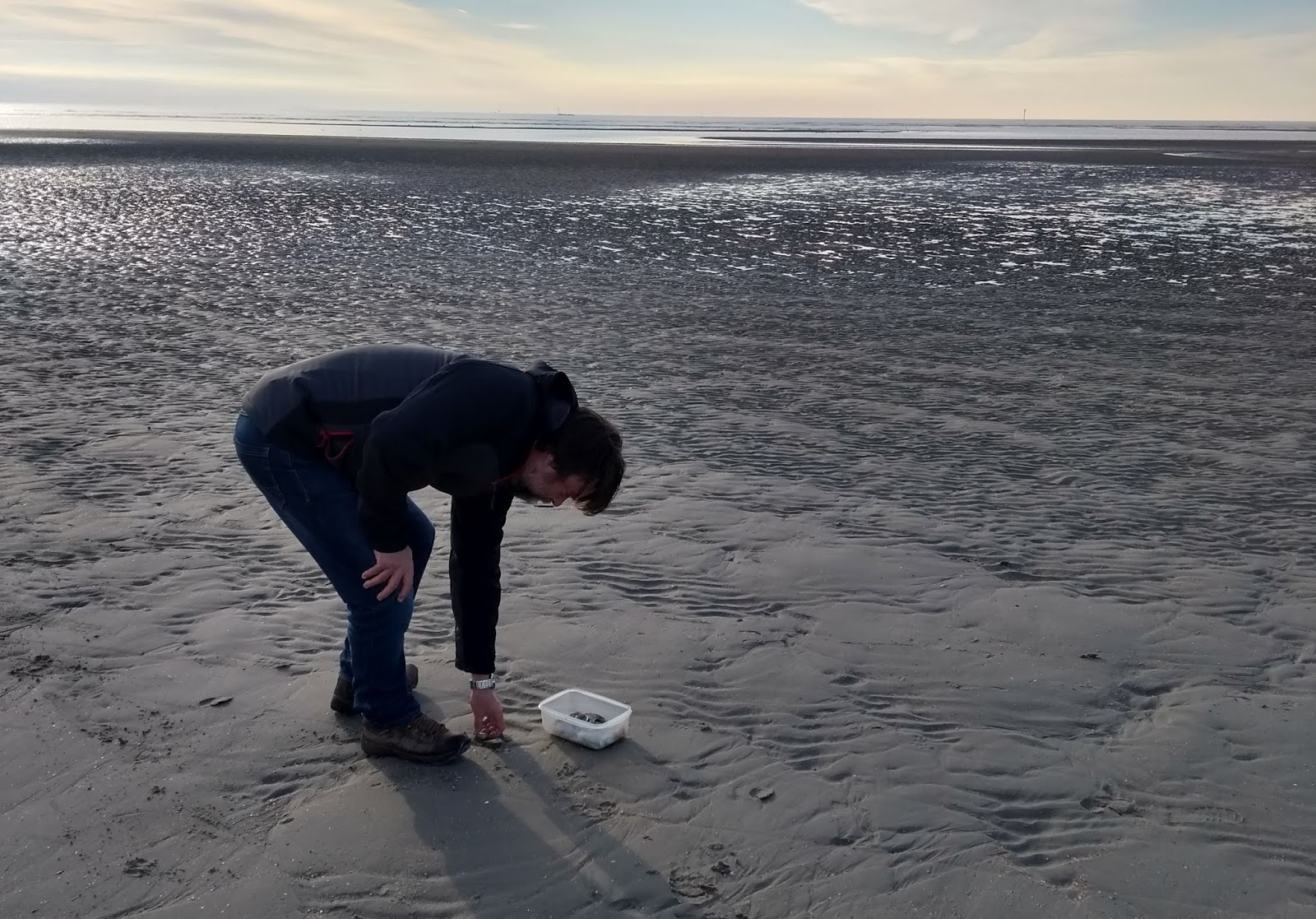
But first thing first: collect sea shells! Over the xmas holidays, we went beach-combing several times in order to collect a wide variety of shells (for this set, I only want molluscs). I didn't have clear ideas yet as to what the pawns, rooks, knights, bishops, queens and kings should look like; that would be determined completely by what we could find. To give us the greatest variety of shells to work with, we collected both from shingle and sand beaches near where we live along the south coast.


Couple of hours collecting usually resulted in several containers full!


Not surprisingly given their biology, shells from shingle beaches were mostly gastropods, whereas bivalves were much more common when collecting on sandy beaches.


Methinks, I've got enough to make a set!


As I'm writing this, my ideas as to what shells to use for which piece are starting to take shape. I've not given a time frame to the 'customer'; the set will be ready when it's ready. But you can be sure it will feature in a blog post once it's done; watch this space!

Wednesday, January 2, 2019

Byzantine chess set

The next set I made started out as a small set on a square 8 x 8 board. The pieces were made from small Dutch 10 cent coins ('dubbeltjes'); the 'white' pieces were not painted, but the 'black' pieces were painted metallic green. The board was made from squares cut from dollar bills.

After moving to the UK, when I became more and more aware of the large number of historical chess variants, I decided to change the board to one used for Byzantine Chess, a circular medieval Persian variant. A circular chess board was carved into, and then painted on, a tree stump, using silver and metallic green paint.


Like several of the older chess sets I made, this set also got lost somewhere along the way, and the two pictures above are the only evidence of it. At least, I think it did ... I'm absolutely sure I didn't take the tree stump with me in every subsequent house move, but I'm not ruling out that the pieces, small as they are, are still hiding in a little box on the attic somewhere. It was a neat little set; the two boards were rather amateurish, but the pieces themselves were fun to create. Should I indeed still have the pieces somewhere, I'll make sure to create a new board for them. Or, if the pieces are truly lost, I may well create another set from small coins in the future.

Tuesday, December 18, 2018

Xiangqi set

It was Xiangqi, Chinese chess, that first made me aware that there are multiple variants of chess. I was introduced to the game by a friend of mine, 'Mijn Kees', and we played several games with his set. Keen to get my own set, I bought a typical Xiangqi set in a Chinese shop in Leiden: disks with red and green Chinese writing and a folded-up paper board. Board like that works fine if you want to play a game, of course, but I wanted to create something a bit nicer ...

I finally ended up with a board which basically consists of cocktail sticks, lots of cocktail sticks: well over 1000 of them! Yes, it took a lot of time finishing it.


'Mijn Kees' and I used the board a lot when I still lived in the Netherlands, and, for a while after I moved to the UK, I had it out when we played games over email.

Fast forward something like 20 years: I still had the pieces in a drawer, while the board had ended up in the back of the shed, damaged and dirty. It clearly was in need of some TLC!


Time to clean it up, restore it, and, where possible, make it look even nicer than it did originally. Damaged sticks in the 'river' were removed, and the 'river' was given a fresh lick of black paint in order to make it match the black lines of the board better.


I then took the decision to use cocktail sticks for inlaying the 'river' as well, but with their orientation turned 90 degrees compared to the rest of the board. Time had given the original cocktail sticks a somewhat darker colour, which actually worked well as it enhanced the contrast with the 'river'.


Next step was to inlay the two 'palaces', with cocktail sticks at a 45 degree angle to those on the main board.


Edges, made from matchsticks, were cleaned, sanded down, and finally dark-varnished.


Final step in the restoration was to clean up the pieces, and my Xiangqi set had been brought back to life again, looking better than ever!


This being the third chess board I ever made, I'm still pretty chuffed with it close to 30 years later. Very glad that this one did survive!