Tuesday, February 2, 2021

Indonesian (?) set


Saw this on eBay (where else?). Nicely-carved wooden box, which opens up to a chess board.


Pieces are kept inside the box, and are also carved from wood.


There is nothing in or on the box to suggest where the set was made, but from the style of the pieces, I strongly suspect they're Indonesian in origin.


Wherever they come from, definitely a unique addition to my collection!

Saturday, January 23, 2021

Louis XIV set

This Louis XIV chess set kept popping up on eBay, and at some point, I just couldn't resist any more. Didn't come with a board, but I felt it would look good on the red wooden board from my Roman set.

Guess the set appealed to me because of the dynamic nature of especially the bishops and knights. Also, it's quite a chunky set, similar in that way to my Royal Beasts set. 


Not much else to say about it, I guess, but I do think it works well on this particular board.

Friday, January 15, 2021

Gwangsanghui

Not much is known about the origin and history of Janggi, or Korean chess. Some characteristics, such as the absence of the river, suggest it may represent an older form of Xiangqi (Chinese chess) rather than 'just' be a xiangqi variant.

Even less is known of Gwangsanghui, a larger Janggi variant other than that it appears to date from the 18th century. I got my information on this larger game here, and the initial layout of the board and pieces appears to be like this:


I was keen to make myself a gwangsanghui set, using glass pebbles for the pieces, and transparent perspex for the board.

Thought long and hard as to how to make the lines, and finally decided on painting them on the underside of the perspex. In order to do that, I first drew the board on a piece of cardboard, put that underneath the perspex ...


... and then started painting the lines, using the template underneath.


Bit of a tricky job, as I had no margin for error: it wouldn't be possible to 'erase' any mistake from the perspex. But all went fine!


I then added four glass pebbles to the board to serve as small 'feet'.


For the pieces, I cut out their symbols, and glued them underneath the glass pebbles.


And this is then what the full set looks like:


Very pleased with it! And the fact that the lines aren't perfectly straight adds something to the board, I think.


There can't be many gwangsanghui sets in the world, I reckon ....


Monday, January 4, 2021

Spear's set

You probably wouldn't think 'vintage' when you see a plastic chess set, but I consider this Spear's set to be close to vintage. Not sure when it was made and sold, but I reckon it's 40-50 years old (someone correct me if I'm wrong!).


The set doesn't come with a board, but I felt the pieces would nicely match the board that came with my pseudo-Italfama set.


The design of the pieces is more interesting than the bog-standard plastic pieces you can get everywhere for almost nothing. So a nice addition to the collection, I think.


Tuesday, December 29, 2020

Dollhouse xiangqi set

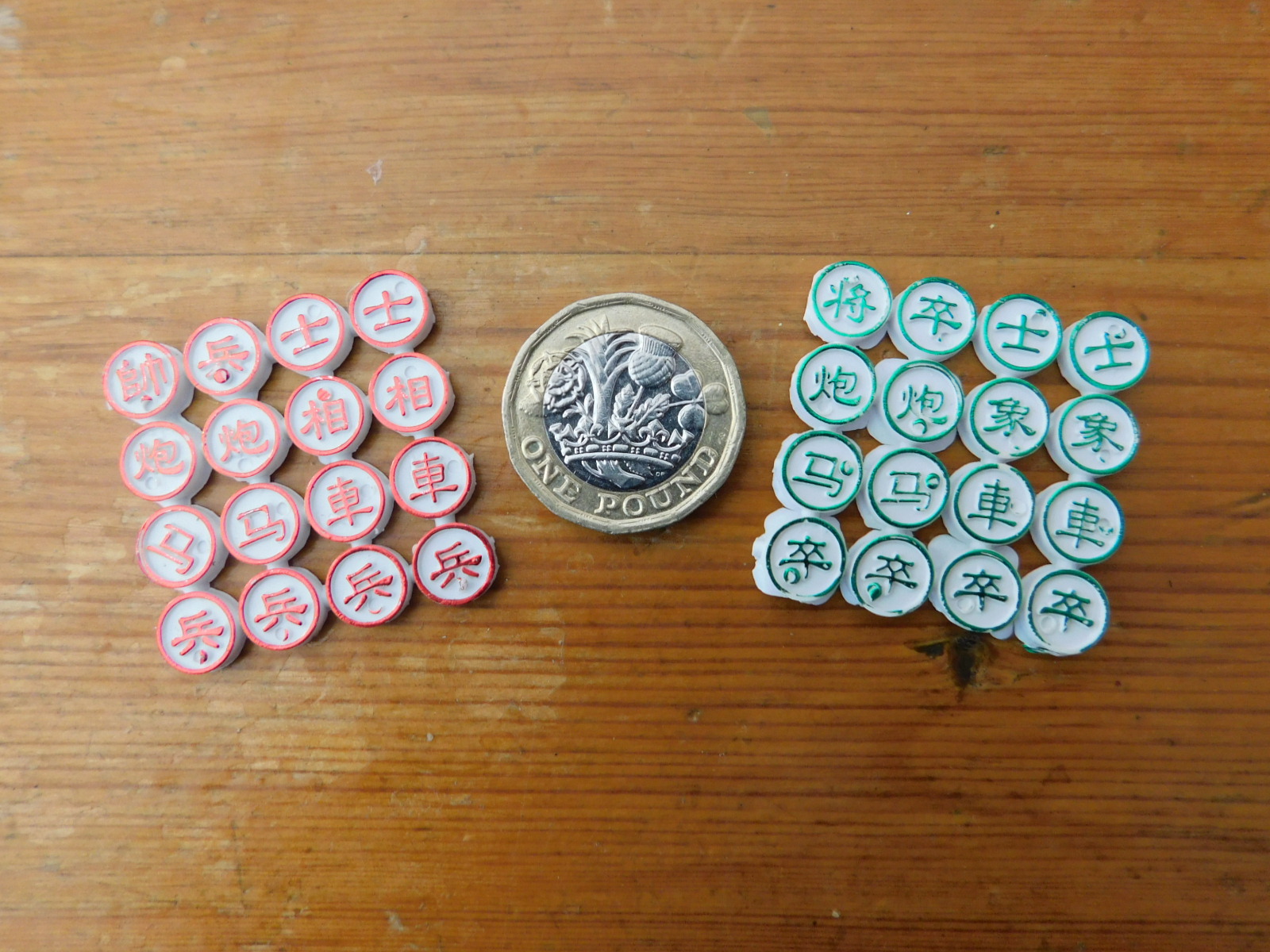
I saw this 'dollhouse' xiangqi set on eBay and I just had to get it!


Inside the little plastic box is a folded-up paper 'board', and the pieces, still connected. They needed separating, and some TLC to file away the rough edges as much as possible.


And to give you a sense of scale, a pound coin in-between ..


I wanted to have a board which was a bit nicer than the folded-up piece of paper, and decided on getting two semi-translucent Perspex discs. The idea was to have the paper board in-between those discs.


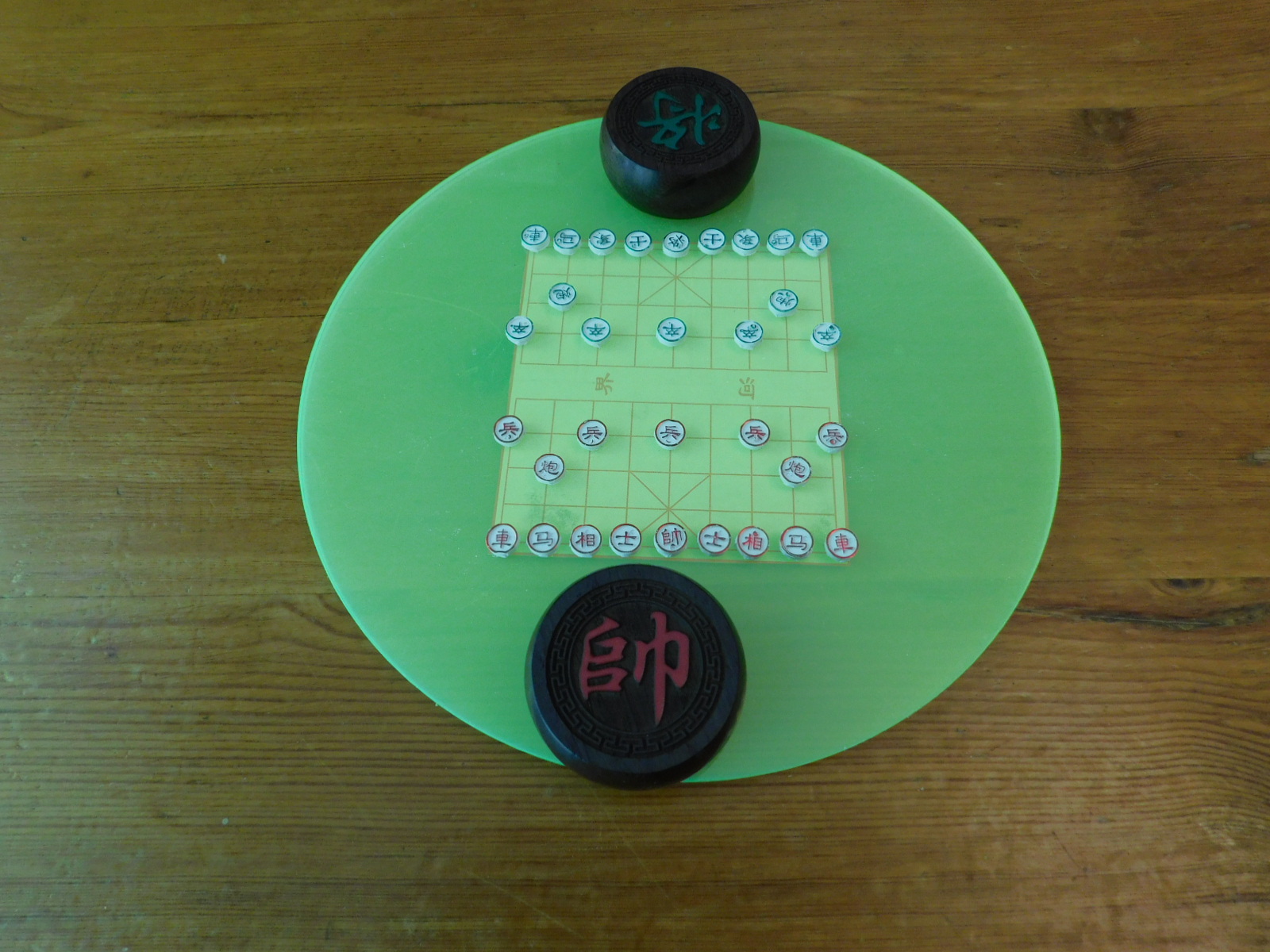
And this is then what the full set looks like:


The smallest set in the collection! Just had to take a picture of this dollhouse xiangqi set together with the 'generals' of my largest xiangqi set ...


Thursday, December 24, 2020

Beach xiangqi set

A year ago to the day, we went out to collect flat round stones from a pebble beach nearby.


The idea was to create a xiangqi set for 'outdoor use', and flat round stones would be perfect for that. For all kinds of reasons, the idea remained just that, an idea, and the stones were patiently waiting in a bag in the shed .... Until earlier this week!


Chinese symbols duly painted on the stones ...


... and, with the pieces done, where better to create an outdoor board than on a beach? So down to Wittering beach on a cold but beautiful day. First measured out and drew the board ...


... and then added the pieces to it. 


Rather than set up the board and pieces for modern xiangqi, I decided to do so for a reconstruction of xiangqi as it is thought to have been played during the Tang and Song dynasties. This reconstruction is by Himly, and dates to 1870.


In terms of the board and initial set-up of the pieces, the main differences with xiangqi as it is played nowadays are the absence of the river (like in modern Janggi), six pawns rather than five, the cannons starting on the back row, a single guard rather than two, and the kings starting in the centre of the palace (like in modern Janggi). There are also differences in the moves of the pieces (e.g. the chariot only moves forward, like the 'lance' in modern Shogi). 


By the way, I did paint the symbol of the guard on the reverse of the 'extra' pawns, so the set can be used for modern xiangqi just as well.


Friday, December 18, 2020

Laser Chess

When is a board game a chess variant? Guess we can discuss this until the cows come home, and there are different opinions on the matter. Even so, no matter where you draw the line, there will always be a grey area ...

Enter Laser Chess. To me, this is still a chess variant, because (1) it has a number of different pieces, with different moves and/or powers, and (2) the capture of a single piece (the 'king') decides the game. Laser Chess fulfils those criteria, so ...


Besides a king, Laser Chess has 'switches', 'deflectors' and 'defenders', which can all move. Plus a 'laser', which is stationary. The 'switches', 'deflectors' and 'defenders' have different reflective (mirrors), blocking, and vulnerable surfaces, whereas the king only has vulnerable surfaces.


The stationary 'lasers' can be fired at the end of every move, with the aim of hitting the king, making use of the mirrors on its own pieces. The opposing pieces are moved such that they screen the king from being hit, but if they have vulnerable surfaces, they can be hit as well, and are then removed from play. Essentially capturing from a distance.


In case all this sounds a bit familiar to anyone, in the 1980s there was a computer game called 'Laser Chess', which worked on the same concept. It had that annoying video voice saying "You can't do that!" if you tried to make an illegal move ...