Monday, August 26, 2019

Staunton set

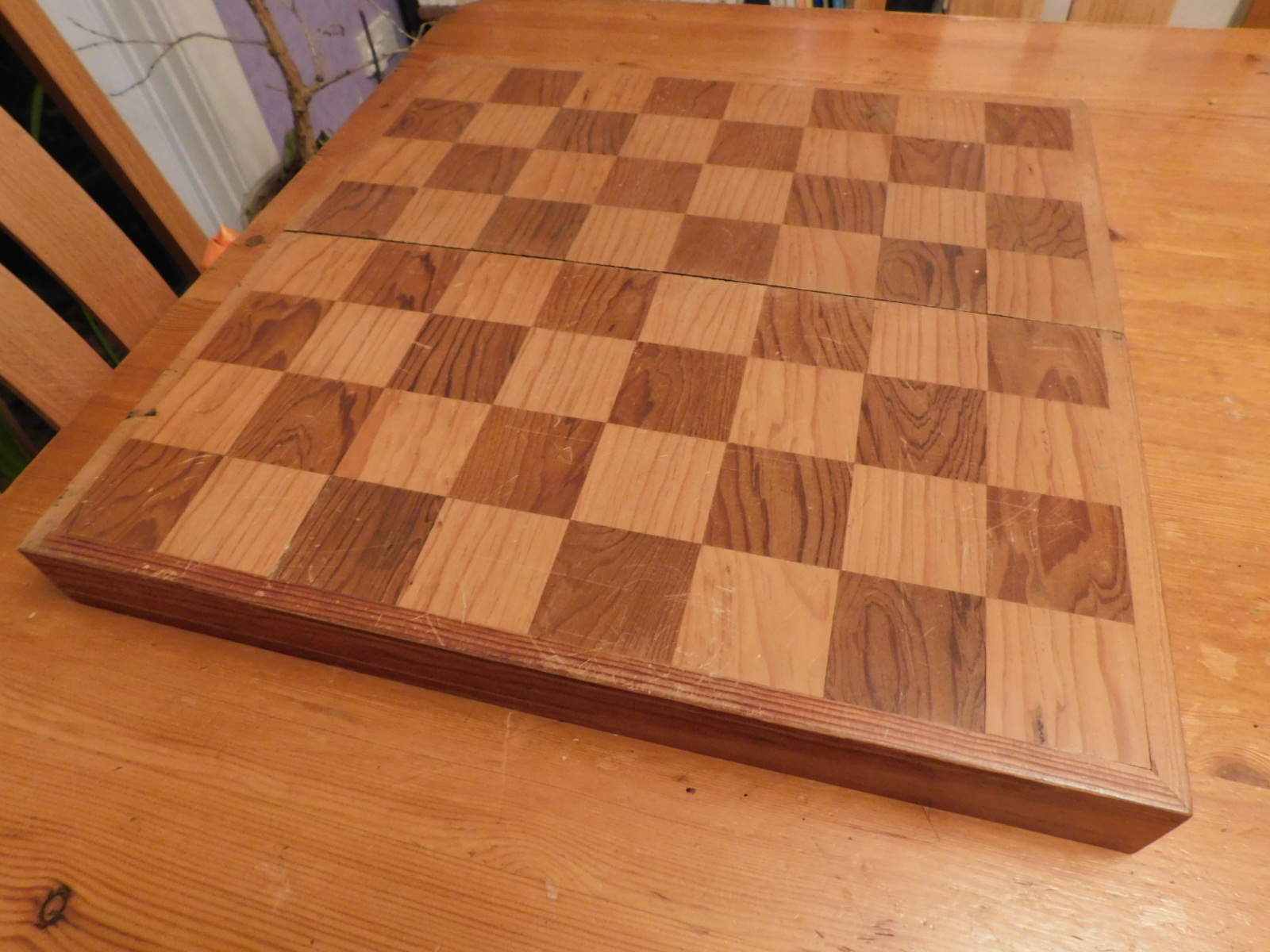
Recently, my collection of created chess sets and/or boards expanded a bit into vintage chess sets in the form of a Mexican pulpit set. That made me think that my collection would always have a glaring hole if it didn't contain at least one set of Staunton chess pieces. eBay is your friend, and I soon found what I felt was a very nice looking set of weighted pieces; I especially like the knights of this set! It didn't come with a board, but I got a nice carved wooden board off eBay, which complemented the pieces pretty well in terms of size as well as general character.


The eBay listing gave no information on where and when the set was made, so I don't know whether it is truly vintage.

Tuesday, August 13, 2019

Chess computers

You could argue that the two chess computers I bought long ago also qualify as 'chess sets', so I ought to mentally add them to the collection.

First chess computer I bought is a Saitek Kasparov Simultano.


Got it about 30 years ago, when I still lived in the Netherlands. It still works fine!


The second chess computer I got shortly after I came to Britain; don't remember exactly when, but it must have been at least 20 years ago. This is a Novag Chinese Chess computer, so programmed to play Xiangqi.


Like its FIDE chess playing sibling, it still works flawlessly.


I guess that specialised chess computers like these are pretty much redundant nowadays, with so much chess-playing software available both off-line and on-line. So they add a bit more 'vintage' to the collection, maybe?

Wednesday, July 24, 2019

Makruk set

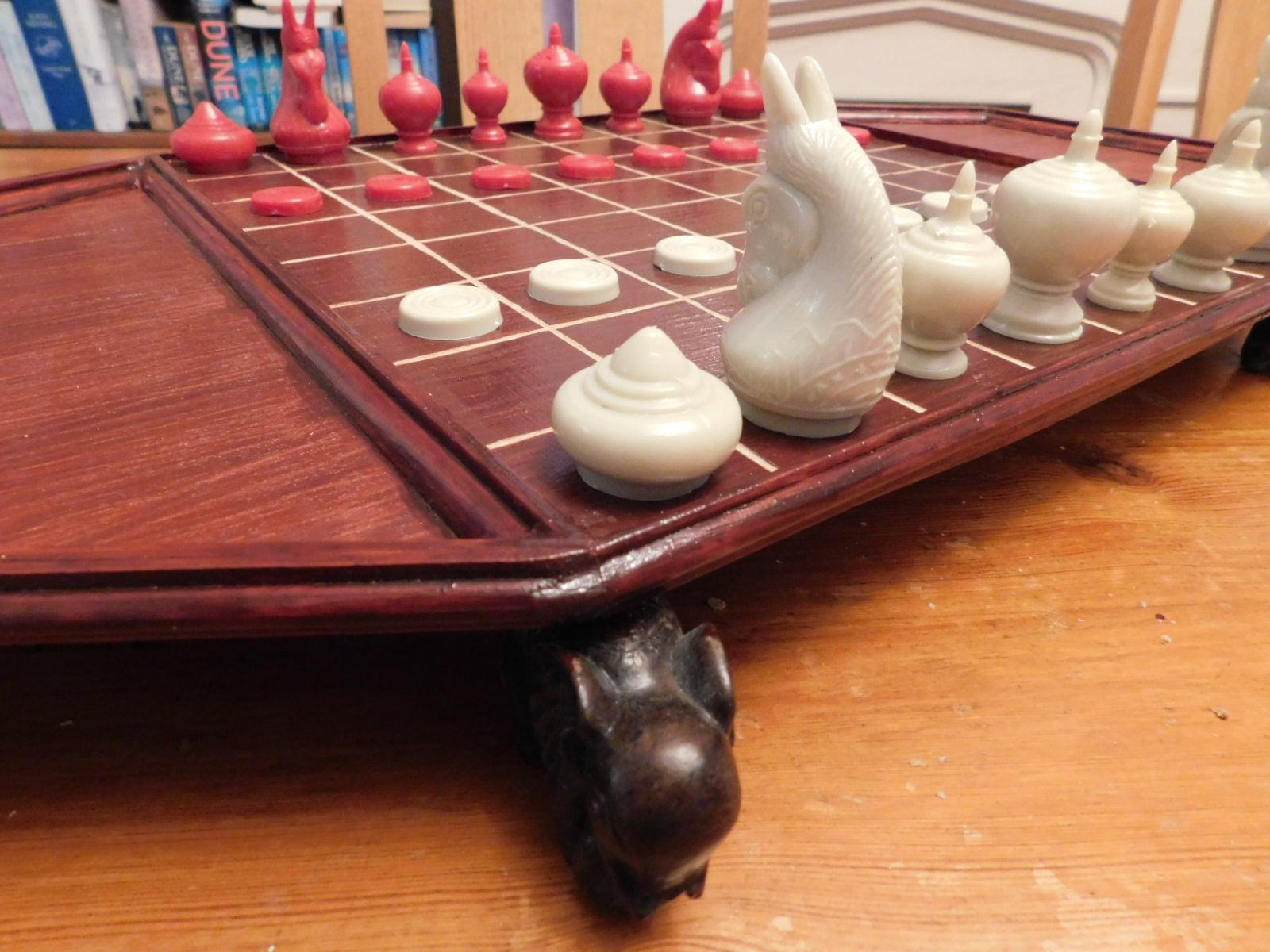
Several years ago, I created a set for Makruk (Thai chess), but, other than the line-up of the pieces, there wasn't anything 'Thai' about either the board or the pieces. So I decided to try again, and make a more authentic Makruk set.

Looking for ideas, I quickly stumbled across a set of original plastic Thai Makruk pieces.


With the pieces sorted, the plan was to create a board similar to boards used in Thailand, with space on the side for captured pieces.


But I wanted to it to be unique, so it would have some changes and an extra flourish!

The playing area was going to be raised a wee bit, on top of the base of the board.


The plywood received three coats of mahogany wood stain, and the lines between the squares were chiselled into the wood, creating light lines in the process
.


The base of the board received two coats of mahogany wood stain, making it slightly lighter than the playing area itself.


And then the extra flourish! Eight small wooden figurines of elephants, a well-known Thai icon. These elephants will carry the board in a rather discworld-esque way.


The base of the board is screwed on to the backs of the elephants, ...


... and then the playing area is glued to the base of the board.


Finally, the board is finished off with several wooden strips, which are mahogany-stained as well.


Time to add the pieces!


I'm really pleased with how my second attempt at a Makruk set came out!


Sunday, July 14, 2019

Chess variants and the origin of chess

If you've been following this blog, you will have seen references to several different chess variants: Xiangqi, Byzantine chess, Makruk, Chaturaji, Shogi, Janggi, Shatar, Klin Zha, Tridimensional chess, Courier chess, Chaturanga.

But these are only the tip of the iceberg: there are, literally, thousands and thousands of chess variants, and more are continuously being thought of by people around the world. If you want to get a feel for this wide range of chess variants, check out the Chess Variants web-site, or the Classified Encyclopedia of Chess Variants.


With so many chess variants, past and present, in existence, the ultimate question is obviously: where did it all start? Where and when did chess originate, and what did that ancestor of all chess variants look like?

The simple answer is: we don't know, at least not for sure. But what little evidence there is suggests it is most likely that India is the birthplace of chess, possibly in the 6th century. The oldest known form of chess is the Indian game of Chaturanga, which fits with an Indian origin. From India, the game is thought to have travelled west to Persia and then the Arab world, through which it entered Europe (via Spain and/or Italy) in the 10th century. Similarly, under the 'out of India' hypothesis, the game spread east to China, southeast Asia, and Japan. Mind you, there are competing theories, one of them being that chess originated in China, centuries before it arrived in India. Evidence for this 'out-of-China' hypothesis is mostly wishful thinking, though; hard evidence is essentially non-existent. For anyone interested to read deeper into the topic, here is a recent in-depth overview of the available literary and archaeological evidence.

Being an evolutionary biologist by training and profession, I came to see this whole group of chess variants as so many different 'species', all descending from a single ancestor. Just like biological species, chess variants mutate, evolve, and go extinct. To give just one example: the queen in modern chess evolved in the late 15th century from the medieval vizier, which was quite a weak piece. Very quickly, this new "mad woman's chess" spread through Europe, replacing the medieval form of chess, which basically went extinct.

There are sophisticated statistical tools available to try and reconstruct the evolution of a group of species, and I decided to apply some basic 'phylogenetic methods' to chess variants, hoping it would shed some new light on the identity of the ancestor of chess. If you're interested to read the article I published in Board Games Studies, you can download the entire text of volume 3 (which includes my article Origin of Chess - A Phylogenetic Perspective) here; alternatively, drop me a message, and I can email you a scan of the article as a pdf. The bottom line is that the phylogenetic analyses I did also support India as the most likely birthplace of chess, and Chaturanga the most likely ancestor.


Tuesday, July 9, 2019

Mexican pulpit set

Saw this set on eBay, and got it as it looked quite unusual in having wooden pieces with what looked like bone on top.


The pieces indeed were wood and bone. As the board that the pieces came with looked rather dirty and dull, my initial thought was to create a new board for the pieces, possibly along some animal theme.

As I was curious as to where and when it could have been made, I posted the picture on the Chess Collectors Facebook group. Very quickly, several group members identified it as a Mexican pulpit set, made in the 1960s and 1970s.

Knowing a bit more about it, and being made aware it's roughly half a century old, I felt I ought to keep pieces and board together. So I cleaned up the board as best I could, and treated it with walnut oil. The 'before' and 'after' pictures don't quite capture it, but the oil really brought the grain to the fore and made the board come alive again!


So here it is, my first 'vintage' chess set!


Possibly the start of a wee side collection of vintage chess sets and pieces?

Thursday, June 27, 2019

A second Shogi set

I wrote about making a Shogi set many years ago, and that in hindsight I wasn't that happy with it. Too gaudy, not 'Japanese' at all. So I decided to try make another set. Rather than make the pieces myself, I bought a traditional set of pieces off eBay, and decided to focus my creative attention solely on the board.


As a basis for the board, I got myself a rubberwood cutting board. I felt the colour would fit nicely with the pieces, and also liked the 'feel' of the wood.


I wanted a simple board, and uhm-ed and ah-ed quite a bit as to how to create the squares. Got ideas and then rejected them again later when I came to the realisation it just didn't quite work. To make a long story short, I finally decided on simple pyrography: burn the lines into the board, using a soldering iron.


Must admit I was pretty pleased with how it turned out! Plus it gave me an unexpected bonus: burning the lines into the wood smells quite nice.


Traditional Japanese shogi boards sometimes have short 'feet' of some sort, turning the board into a very low table. I wanted to do something along those lines, and got myself four wooden half-spheres, to serve as 'table legs'.


Final flourish was to burn the Japanese characters for 'shogi' into the board. That area of the board is where the captured pieces are to be kept, in preparation for a 'drop', and in clear view of the opponent.


Which means the board is ready for the pieces.


I'm much happier with this simple shogi board; leaves the old one far behind!

Friday, June 14, 2019

Kama Sutra set

What little evidence there is points to India as the birthplace of chess, so I was keen to create a real Indian set. Looking for inspiration on eBay, I stumbled across a listing of a resin set of Kama Sutra pieces. What could be more Indian?


As to the board, my ideas gradually converged on making a quilted board from sari fabric. Keep in mind that I'd never done any quilting, in any way, shape or form ...

Sari fabric, in four colours, was quickly ordered.


Why four colours, you might ask? Two colours for the 'white' and 'black' squares (green and purple, respectively), one colour for the edges of the board (blue), and, in a nod to the 'ashtapada' board that Chaturanga, the oldest known form of chess, was played on, red for the special ashtapada squares.


By the way, current thinking is that this ashtapada board was used for a race game, and then used for playing chess at a later date; the marked squares were likely entry and exit squares for the game, or possibly safe squares.

Back to my Kama Sutra set, the playing area of the board was constructed from 64 sari squares, in green, purple, and red, sewn together.


Then, blue strips were added along the sides of the playing area.


Quilting wadding to give the board a bit of volume, and sewing together of top surface, wadding, and a large blue square of sari fabric that was to form the underside of the board.


Next step was to sew between all the squares, and thus the playing area became fully quilted!


Final step was to finish off the edges of the board.


And the board is done!


So all that remains to be done is to put the pieces on the board.


The board is certainly not perfect, but given that I've got very limited experience using a sewing machine; that sari fabric is very difficult work with (for me, at least; it's very slippery and stretchy, and no amount of pins stopped that); and that I'd never done any quilting, I'm pretty pleased with how it turned out.


The pieces, the board and the colours all work together, and it's definitely unlike any chess set or board I ever made.