Saturday, April 20, 2019

Klin Zha set

If you're a Trekkie, you're probably familiar with Klin Zha, the chess variant played by the Klingons in Star Trek. I did make a Klin Zha set a long time ago, using leather for a board, and leather-on-plastic-triangles for the pieces.


That set is long gone, like so many of my early sets, and it certainly wasn't my best effort, so nothing much lost ...

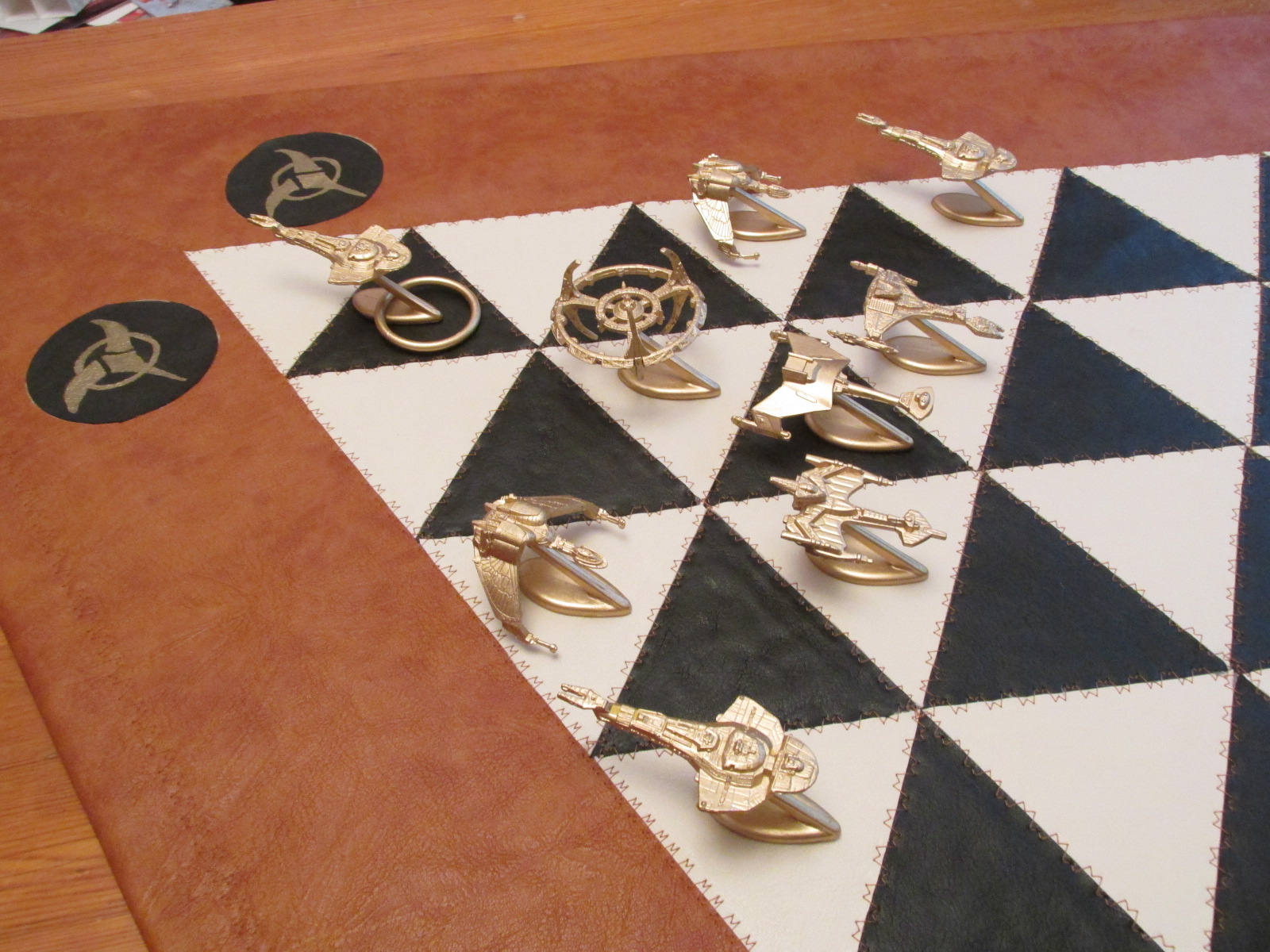
Inspired by some posts on the Klin Zha Facebook page, I decided I was going to have another attempt at creating a Klin Zha set. Considering options, I stumbled across Star Trek micro-machines, and managed to get my hands on a job lot of them off eBay:


Plenty of spaceships to create two sets of pieces! Actually, plenty to create three sets of pieces! One set representing the Klingon Empire, painted gold:


One set representing the Romulan Alliance, painted metallic green:


And one set representing the Federation, painted silver:


Leather is quite a Klingon material, so for the board I decided to stick to leather, in three colours: beige and black for the fields, and brown for the edge of the board.


Trying out different stitches on our new sewing machine, I found one with a clear Klingon 'feel' to it (the top one in the picture below):


First job was to cut out all the triangular fields ...


... and attach them to the back of the board.


Fields were sewn together and to the back of the board using brown thread and the 'Klingon' stitching.


To identify the starting point of each of the three fleets, I created black leather circles with the identifying logos of the three participants painted on.


And then it came down to creating the edges of the board ...


... incorporating the logos at the three points ...


... and folding over and sewing together the edges.


Board done!!


So here, on the board and in close-up, the fleets of the Klingon Empire, Romulan Alliance and the Federation.


As the board is too big to easily store (1.33m each side) it hangs on our bedroom wall when not used.


Creating this Klin Zha set took a lot of time and effort, and even though I say so myself, I'm really proud of it. Most definitely much better than my first attempt, and quite possibly my best chess set so far.

Tuesday, April 9, 2019

Janggi set

My 'second wave' of creating chess sets commenced in 2013, when I restored my old Xiangqi board. While doing that, I found this box with original pieces for Janggi, Korean chess, in a drawer. I don't remember now exactly when and where I got it, maybe eBay, maybe in Chinatown in London. Wherever and whenever I got it, it definitely sat in a drawer for a long time; long enough to finally give the pieces a board to sit on.


I wanted the board to match the pieces, so quickly decided on white Perspex as the material to use. And to make it look a bit better, I felt that a sheet of semi-opaque Perspex on top, through which you could see the lines, could work really nicely.

So Perspex ordered, and lines were drawn on the white sheet of Perspex (like in Xiangqi, play is on the intersections of the lines in Korean chess).


Palaces drawn on the board, and to emphasise them, I added two 'taegeuk' to the centre of the palaces.


Semi-opaque sheet of Perspex glued top of it, and the lines come through clear enough to play on.


So all that remains is to add the pieces!


Even though it's certainly not the most elaborate board I ever made, its simplicity and how well it matches the pieces make me rather pleased with this attempt.

Tuesday, March 26, 2019

Shatar set

A set which didn't receive the slightest bit of creative input from me, but I saw it on eBay and couldn't resist putting in a bid. Turned out I was the only bidder!

Set is one for Shatar, or Mongolian chess. The board is woven from a course type of wool, possibly yak wool?


Pieces are made from resin or something similar. Fun to see the red and orange pawns are different: what looks like rabbits for the orange pawns and something dog-like for the red pawns.


It's quite a small set (the board measures just 25cm square), but a nice one just to have.

Saturday, March 16, 2019

Commissioned sea shells set

A few months ago, I wrote about getting my first commission: creating a sea shells set for a friend. I am pleased to announce that that set is now finished, and handed over to the rightful owner.

When designing the set, one thing was clear in my mind: I did not want it to be a copy of the first sea shells set I made many years ago. Of course, using some of the same shells was unavoidable, but I wanted to make sure it looked quite different.

For the board, I decided on white and red squares, with quite wide black edges. Extra ornamentation in those edges comes from four cockle shells at the corners of the board.


Shells for all the pieces are mounted on wooden discs, using some clay where necessary. Pieces are painted silver and gold, as I felt that would set them off nicely on the red and white squares of the board.


So which shells are for which pieces? Slipper shells are used as the pawns:


The rooks are made of cockles:


Knights appear in the shape of whelks:


The bishops consist of two pairs of mussels each:


Piddocks, also known as 'Angel Wings', make up the queens:


And, finally, the kings are made from razor shells:


I do think the full set looks pretty good!


Even though many of the shells used are the same in this and my earlier sea shells set (cockles, mussels, whelks and razor shells feature in both), the whole looks quite different, which is exactly what I intended.


I think it's safe to say that my friend was very pleased with the set! And his son couldn't wait playing a game with it.


Guys, enjoy it!

Friday, March 8, 2019

Travel set

This wee wooden travel set did not involve any creation from my side.


I got it as a thank-you present from one of my PhD students after he had successfully defended his thesis. The set is really small: just under 13 cm in diameter, with the playing area measuring 8 x 8 cm.


Neat, eh?

Sunday, March 3, 2019

Shot glass set

I got this large shot glass chess set as a present from a dear friend in the US. Different pieces are represented by glasses in different shapes, all on a thick glass board.

You know the rules of 'shot glass chess'? If not, the key difference with 'normal' chess is that the side making a capture has to drink the contents of the captured piece before continuing the game. Typically, the glasses are filled with clear and coloured spirits; in this particular case ...


... gin ...


... and whisky.


The set actually featured in Whisky Magazine, in an article reporting my attempt to play shot glass chess against a computer. For that, I played 'white', and had to drink the content of any whisky-filled piece I captured. As the computer (a Saitek Kasparov Simultano, if anyone wants to know) obviously can't drink anything and get inebriated, the 'white' pieces were filled with water, and the 'shot glass' effect was simulated by lowering the playing level each time it made a capture.


I did win the game! Quite possibly, the first ever shot glass chess game against a computer? If anyone wants a scan of the article in pdf-format, with the entire game score as well as the blind tasting that was part of the game, drop me a message.

Friday, February 22, 2019

Shogi set

Next to FIDE chess and Xiangqi (Chinese chess), Shogi (Japanese chess) is the third of the three 'big' chess variants. As I had already made sets for the first two, I obviously needed to make a Shogi set as well, to complete the 'big three'.

My Shogi set was made entirely from cork: tiles and squares cut from cork tiles to create the board, whereas the pieces were cut from bottle corks, subsequently painted (a different colour for each different piece), and with their Japanese symbol painted on them. As Shogi and some of its variants are unique in that captured pieces become the property of the capturer and can be reintroduced onto the board ('dropped'), the pieces are not differentiated into 'black' and 'white'. Rather, the ownership of a piece is indicated by the direction it's pointing in.


This shogi set was the final set in the 'first wave' of me creating chess sets. This first wave roughly coincided with the 1990s, when, as I said earlier, other interests took over. As is the case with (almost) all the chess sets I made so many years ago, this Shogi set is lost. Looking back at the one remaining picture now, taken while it was 'embedded' in a Japanese maple, I'm not too sad it's no longer in existence. Too cheap and gaudy with the differently coloured pieces. I've got ideas for creating another Shogi set or board, which is more Japanese-styled; watch this space!