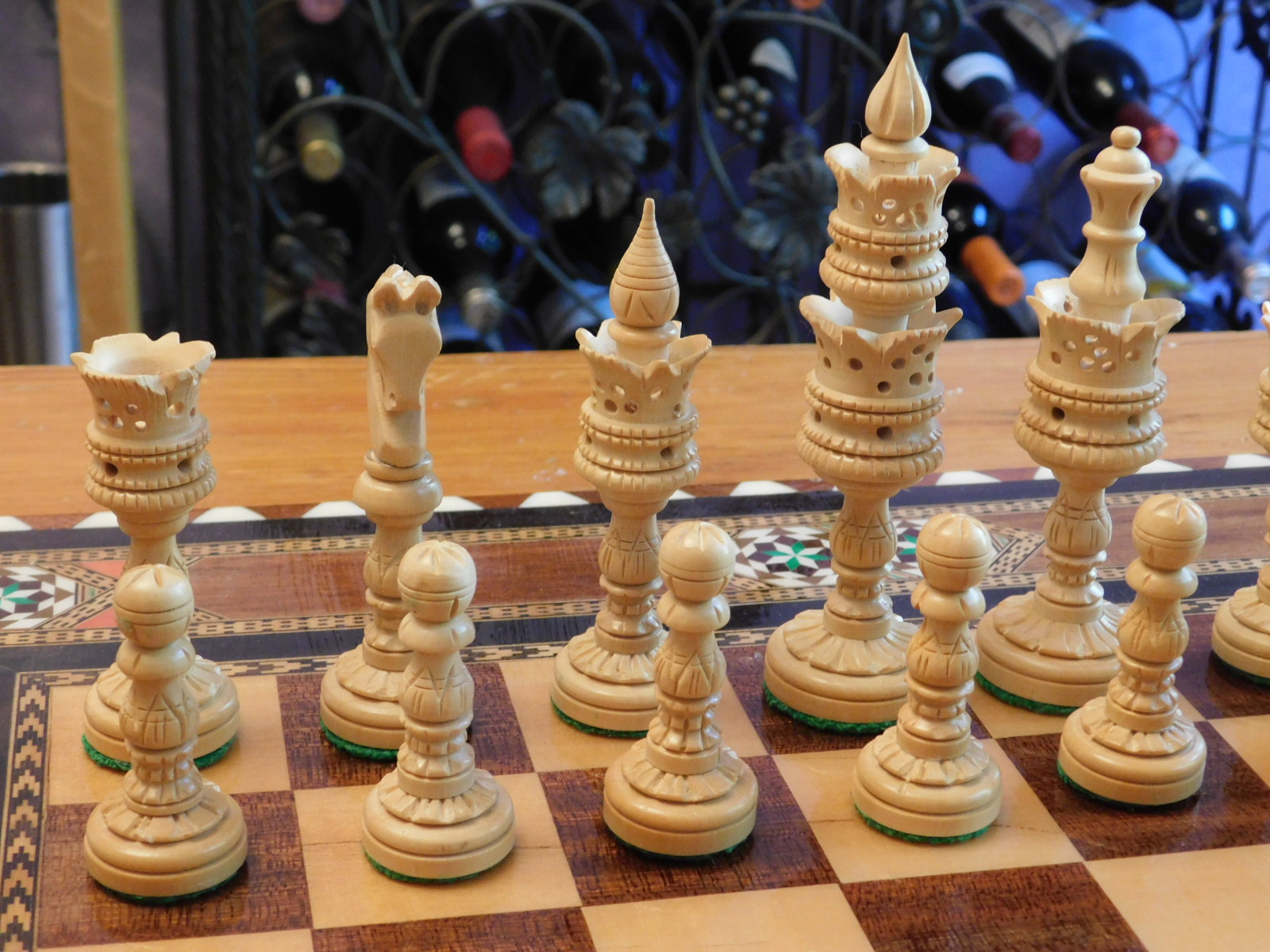
I really like intricately carved chess sets, but most of these offered on eBay or Amazon are just way out of my price league. Until I stumbled across one from India which I was willing to pay the asking price for.
The board is not original to the pieces; I got it off eBay sometime ago just as a board (i.e. no pieces). I really liked it and was sure I would find pieces that fit. My Indian Lotus set definitely does!
How can you not like the artistry?
Beautiful addition to the collection, for sure.
Thursday, March 26, 2020
Saturday, March 21, 2020
Matador & Flamenco set
Got this Spanish set off eBay for not very much. As far as I've been able to ascertain, it dates from the 1960s, or possibly 1950s.
The board is not original board, but one I had lying around and actually fits the pieces well.
It really is a nice set, with a matador as king and flamenco dancer as queen. The bulls acting as knights have a bit of a curious look on their faces ... By the way, let me assure you that me getting this set in no way means I endorse bull-fighting in any way (quite the contrary).
A few more of these sets have been listed on eBay recently. One sold for £150, whereas the starting bid for another one is a mere £395 .... It keeps being relisted, and I've got a watch on it, just because I'm curious someone will go for it. I most certainly wouldn't pay £395 for it, and I got mine for far less than £150!
The board is not original board, but one I had lying around and actually fits the pieces well.
It really is a nice set, with a matador as king and flamenco dancer as queen. The bulls acting as knights have a bit of a curious look on their faces ... By the way, let me assure you that me getting this set in no way means I endorse bull-fighting in any way (quite the contrary).
A few more of these sets have been listed on eBay recently. One sold for £150, whereas the starting bid for another one is a mere £395 .... It keeps being relisted, and I've got a watch on it, just because I'm curious someone will go for it. I most certainly wouldn't pay £395 for it, and I got mine for far less than £150!
Thursday, March 12, 2020
Disney 'Heroes & Villains' set
There are several chess sets featuring Disney characters; this particular one is the 'Heroes & Villains' set.
As usual with these sets, the board is a basic cardboard fold-up board, and the pieces are plastoy.
On the 'Villains' side, we have Shere Khan and the Wicked Queen as king and queen, plus Ursula, Captain Hook, Cruella de Ville and eight Kaa pawns.
And on the 'Heroes' side, we see Simba and Cinderella as king and queen, plus the Beast, Peter Pan, Baloo and Mickey Mouse pawns.
Just like my earlier 'fictional' plastoy sets (Star Wars, Smurfs and Simpsons), the pieces are nicely done.
As usual with these sets, the board is a basic cardboard fold-up board, and the pieces are plastoy.
On the 'Villains' side, we have Shere Khan and the Wicked Queen as king and queen, plus Ursula, Captain Hook, Cruella de Ville and eight Kaa pawns.
And on the 'Heroes' side, we see Simba and Cinderella as king and queen, plus the Beast, Peter Pan, Baloo and Mickey Mouse pawns.
Just like my earlier 'fictional' plastoy sets (Star Wars, Smurfs and Simpsons), the pieces are nicely done.
Friday, March 6, 2020
Wooden turned set
The story of this wooden turned set, listed on eBay for not very much, is quite brief. I'm not aware of it being 'vintage' in any way or it having any specific historical significance, but I just liked the shapes of the various pieces and the way the board was carved.
So I bought it, simple as that!
Monday, March 2, 2020
Pasta Xiangqi set
As I'm sure you're aware, pasta comes in many different shapes, and I always had a vague plan in mind to make a chess set using different pasta shapes. That idea sort of simmered in the back of my mind for quite a while, until I decided to create a xiangqi set using pasta.
As xiangqi pieces are normally flat discs, I decided to use ruote as the bases for all pieces, and add different shapes on top to differentiate the pieces. A rainy-day trek past a few shops gave me enough different pasta shapes to make this work.
We'll eat lots of pasta in the foreseeable future ...
But first the board. Piece of plywood, painted red, formed the base of the board, and linguine was used to create the lines.

Xiangqi boards normally have the starting positions of canons and pawns indicated, and I used stelle to do that.
Board done!
So on to the pieces, and I decided to paint the differentiating parts of the pieces red and black, but leave the ruote bases 'pasta-coloured'. I also wanted to use similar, but not identical pasta shapes for the two sides' general/marshal, elephants/ministers, and pawns, as traditional xiangqi sets use alternative Chinese writing for the red and black versions of these particular pieces.
Starting with the pawns, I used macaroni, in two different configurations for 'red' and 'black'.
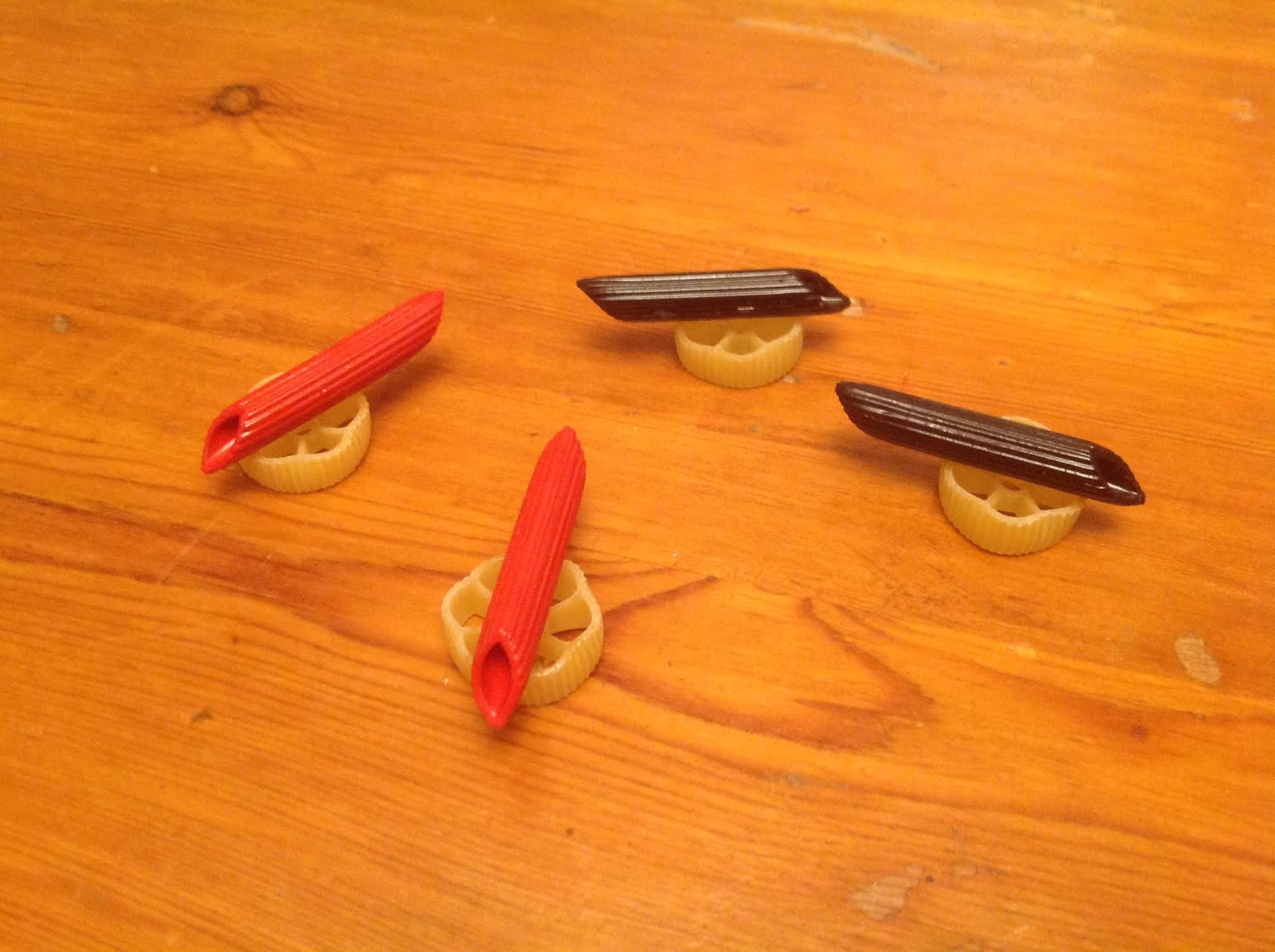
For the cannons, I used penne. Pretty obvious why, right?
The chariots (rooks) have mafalda corta as their distinguishing pasta shape.
Farfalle was used for the horses (knights); I do see the knight move in the shape.
For the ministers and elephants, I used similar shapes: conchiglie and gnocchi.
The guards are represented by dischi volanti.
And, finally, the marshal and general (the king in xiangqi), for which I used fusilli and fusilli bucati.
Let's put all the pasta pieces on the pasta board!
I'm pleased with how my pasta set turned out; definitely a set unlike any I've made so far. I think the word 'quirky' captures it quite well!
As xiangqi pieces are normally flat discs, I decided to use ruote as the bases for all pieces, and add different shapes on top to differentiate the pieces. A rainy-day trek past a few shops gave me enough different pasta shapes to make this work.
We'll eat lots of pasta in the foreseeable future ...
But first the board. Piece of plywood, painted red, formed the base of the board, and linguine was used to create the lines.
Xiangqi boards normally have the starting positions of canons and pawns indicated, and I used stelle to do that.
Board done!
So on to the pieces, and I decided to paint the differentiating parts of the pieces red and black, but leave the ruote bases 'pasta-coloured'. I also wanted to use similar, but not identical pasta shapes for the two sides' general/marshal, elephants/ministers, and pawns, as traditional xiangqi sets use alternative Chinese writing for the red and black versions of these particular pieces.
Starting with the pawns, I used macaroni, in two different configurations for 'red' and 'black'.
For the cannons, I used penne. Pretty obvious why, right?
The chariots (rooks) have mafalda corta as their distinguishing pasta shape.
Farfalle was used for the horses (knights); I do see the knight move in the shape.
For the ministers and elephants, I used similar shapes: conchiglie and gnocchi.
The guards are represented by dischi volanti.
And, finally, the marshal and general (the king in xiangqi), for which I used fusilli and fusilli bucati.
Let's put all the pasta pieces on the pasta board!
I'm pleased with how my pasta set turned out; definitely a set unlike any I've made so far. I think the word 'quirky' captures it quite well!
Wednesday, February 26, 2020
A pair of Chess Bazaar replica chess sets
Two wooden replica chess set made by Chess Bazaar were listed almost simultaneously on eBay, both for very reasonable prices, and my 'buy-it-now' finger took the decision. Turned out they both came from the same seller, so I saved a bit of money on shipping costs.
First set is a replica of the ANRI Space Age set, and it fits perfectly on my 'Kasparov' board.
I really like the elegant shapes of the pieces.
Second set is a Chavet 'Karpov' replica set. Slightly larger and chunkier than the more elegant Space Age set, it didn't fit comfortably on the 'Kasparov' board, but my larger tournament board was perfect for it.
The pieces are quite heavy and really feel nice to handle.
By the way, both sets came with extra queens. Seller said he was glad the two sets remained together and went to a good home!
First set is a replica of the ANRI Space Age set, and it fits perfectly on my 'Kasparov' board.
I really like the elegant shapes of the pieces.
Second set is a Chavet 'Karpov' replica set. Slightly larger and chunkier than the more elegant Space Age set, it didn't fit comfortably on the 'Kasparov' board, but my larger tournament board was perfect for it.
The pieces are quite heavy and really feel nice to handle.
By the way, both sets came with extra queens. Seller said he was glad the two sets remained together and went to a good home!
Thursday, February 20, 2020
Tamerlane Chess set
Tamerlane Chess, aka Timur's chess, is a chess variant dating back to 14th century Persia. It has more different pieces than FIDE chess, and each pawn is linked to a particular major piece (and can only promote to that piece). To accommodate the higher number of pieces, the board is 10x11, and has, in addition, two citadels. These citadels are basically escape squares: if a king reaches the opposite citadel, the game is drawn. Full rules can be found here, and the initial set-up looks like this:
When we went collecting shells for my first commission of making a chess set, we collected many more shells than I needed in the end. As I always wanted to make a set for Tamerlane Chess, it made sense to use the remaining shells for that (plus that sea shells are very good for making chess sets!).
I decided to make the board not square, but have the sides slightly slanted to include the citadels.

The squares were to be made from mother-of-pearl tiles and I do feel the board came out very striking.


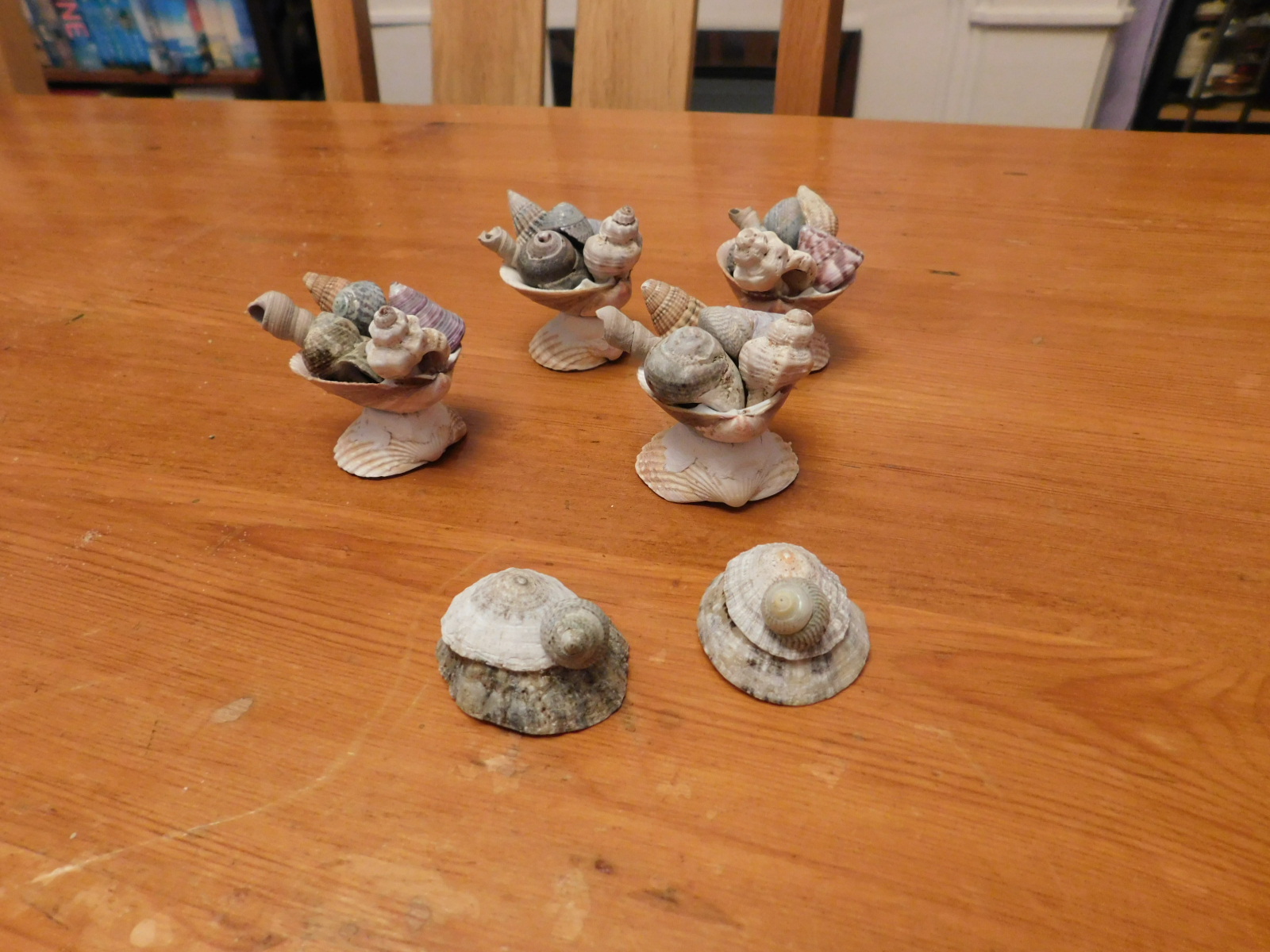
Then on to the pieces! I had a lot of fun thinking through their design, and deciding which shells to use for which piece. Here are pictures of all pieces, with their associated pawns, both 'raw' and painted. The pawns are all made using limpet shells, and for each pawn, I've taken a small version of the (main) shell used for the major piece as an identifying trait. The only exception to this is the 'pawn of pawns', the only pawn not linked to a major piece (its promotion rules are quite complex, too complex to discuss here).

Dabbaba (war engine), using surf clams

Jamal (camel), using scallop shells

Pil (elephant), using whelks

Rukh (chariot aka rook), using slipper shells

Faras (horse aka knight), using mussels

Talia (vanguard), using various snail shells

Zurafa (giraffe), using razor shells

Wazir (vizier), using sepia shields and cowries

Ferz (general), using piddocks

And finally, the shah (king), using oysters and (fake) pearls. This piece being the king, the pearl is the only part of any piece that's not painted.

And here's what the set looks like with all the pieces on their starting squares.


Several set-ups and variants (e.g. a 'Full' Tamerlane chess, with additional pieces) are known from various literary sources. The set-up used above is the common 'masculine' set up; as you might expect from the name, there is also a 'feminine' set up. This 'feminine' set-up uses the same pieces as the common 'masculine' set-up, but with some of the pieces in the centre on different starting squares.
I must say I'm really pleased with how my Tamerlane Chess set turned out ...
When we went collecting shells for my first commission of making a chess set, we collected many more shells than I needed in the end. As I always wanted to make a set for Tamerlane Chess, it made sense to use the remaining shells for that (plus that sea shells are very good for making chess sets!).
I decided to make the board not square, but have the sides slightly slanted to include the citadels.
The squares were to be made from mother-of-pearl tiles and I do feel the board came out very striking.
Then on to the pieces! I had a lot of fun thinking through their design, and deciding which shells to use for which piece. Here are pictures of all pieces, with their associated pawns, both 'raw' and painted. The pawns are all made using limpet shells, and for each pawn, I've taken a small version of the (main) shell used for the major piece as an identifying trait. The only exception to this is the 'pawn of pawns', the only pawn not linked to a major piece (its promotion rules are quite complex, too complex to discuss here).
Dabbaba (war engine), using surf clams
Jamal (camel), using scallop shells
Pil (elephant), using whelks
Rukh (chariot aka rook), using slipper shells
Faras (horse aka knight), using mussels
Talia (vanguard), using various snail shells
Zurafa (giraffe), using razor shells
Wazir (vizier), using sepia shields and cowries
Ferz (general), using piddocks
And finally, the shah (king), using oysters and (fake) pearls. This piece being the king, the pearl is the only part of any piece that's not painted.
And here's what the set looks like with all the pieces on their starting squares.
Several set-ups and variants (e.g. a 'Full' Tamerlane chess, with additional pieces) are known from various literary sources. The set-up used above is the common 'masculine' set up; as you might expect from the name, there is also a 'feminine' set up. This 'feminine' set-up uses the same pieces as the common 'masculine' set-up, but with some of the pieces in the centre on different starting squares.
I must say I'm really pleased with how my Tamerlane Chess set turned out ...
Subscribe to:
Posts (Atom)